 |
| Click on picture to listen to soundtrack: 'It's a jungle out there' |
Sunday, September 14, 2014
ToK Prescribed Essay TItles (May2015): Question 1
There is no such
thing as a neutral question. Evaluate this statement with reference to two
areas of knowledge.
Where do babies come from?
Remember asking this question to your parents? Do you remember how they
reacted or what they said? Were you
satisfied with the response? Do you remember if you asked a follow up
question? There’s something about asking
questions that drives people crazy, especially curious little children who just
seem to want to ask questions for the sake of it without really appearing to be
interested in the answer. Sometimes questioning can be just playful; a form of
mental gymnastics to keep the mind supple and flexible – you’re not really
interested in gaining any knowledge but just enjoy the ‘trip’. At other times, questions can be dangerous, a
form of intellectual probing which reaches into areas which may be classified
as ‘Top Secret’ or ‘For your Eyes Only’ – you’re poking your nose into
forbidden knowledge and ought to be aware of the risk.

Monday, September 1, 2014
ToK Prescribed Essay Titles (May 2015)
The new essay titles based on the 2015 Guide are printed below. Remember to follow the new assessment guidelines for your work and lots of luck1
1. There is no such thing as a neutral question. Evaluate this statement with reference to two areas of knowledge.
1. There is no such thing as a neutral question. Evaluate this statement with reference to two areas of knowledge.
2. “There are only two ways
in which humankind can produce knowledge: through passive observation or
through active experiment.” To what extent do you agree with this statement?
3. “There is no reason why we
cannot link facts and theories across disciplines and create a common
groundwork of explanation.” To what extent do you agree with this statement?
4. With reference to two
areas of knowledge discuss the way in which shared knowledge can shape personal
knowledge.
5. “Ways of knowing are a
check on our instinctive judgments.” To what extent do you agree with this
statement?
6. “The whole point of
knowledge is to produce both meaning and purpose in our personal lives.” To
what extent do you agree with this statement?
Monday, June 30, 2014
ToK Prescribed Essay Titles (November 2014): Question 1
“Some
areas of knowledge seek to describe the world, whereas others seek to transform
it.” Explore this claim with reference to two areas of knowledge.
Read this post in association with the post on Title 2 of the November 2014 TOK Title list.
You might think that the Arts and Sciences neatly fit into the distinction expressed by this title. The Arts involve imaginative descriptions of the world which draw you into a world of make believe, through words, paint, music or dance, for instance, and you’re thrown back into the real world after the story ends or you disengage from the art work or when the music stops. The Sciences involve a practical application of theories that lead to inventions in the physical worlds of media, technology and industry, for example, and you use the products of this process often without thinking about it and taking it very much for granted.
This distinction often leads people to argue that the Arts are generally useless when compared to the Sciences. How can the Arts ever be anything but secondary to the Sciences? But this would be naive at best and ignorant at worst. In fact, why can’t the Arts and Sciences be both descriptive and transformative? We need both equally and they are both equally crucial to our evolutionary development.
Consider Jonathon Gotschall’s thought experiment. Imagine millions of years ago in the evolutionary beginnings of our ancestors, there are only two human tribes, alike in every way except one, as designated by their names: the ‘Storytelling People’ and the Practical People’. One group is going die out, whereas the other is going to survive.
Here’s how the difference manifests itself: the Storytelling People do their hunting and gathering and mating as the Practical People do, but they get bored easily and when tired out by the day’s activities often spend long hours exchanging tales (sometimes downright lies) about things that have happened, might happen or might never happen at all. They enjoy themselves and have lots of fun making up their fictions while the Practical People don’t have anything to do with the seemingly trivial matter of telling stories; they keep on with their survival activities, hunting, gathering and mating more and more, and when they get tired, they crash with fatigue and sleep to refresh their energies for more of the same practical survival work.
We know the end of this thought experiment, Gotschall argues: the Storytelling People is homo sapiens and they survived; the purely Practical People (if they existed at all beyond the thought experiment) no longer exist. And yet if we hadn’t known this outcome from the beginning and had been asked to predict which of the two groups would survive, surely it would have been the Practical People, whose frugality and efficiency and value systems were more than a competitive match for the frivolous storytellers.
The fact that this didn’t happen Gotschall calls ‘the evolutionary riddle of fiction’. So what is it about our imaginative capabilities, our need for storytelling that gives us such an evolutionary edge?
Some answers are that the human imagination is like a virtual reality ‘holodeck’ which constantly runs internal simulations in which we project ourselves into make believe situations as a practice for real life situations; telling stories is a socialising experience which sharpens our empathetic skills and hones our altruistic nature which gives our species an evolutionary advantage of cooperating when faced with life’s manifest obstacles; moreover, engaging with these internal, imaginary fictions can be done in the safety of our head which takes away the risks and dangers involved in the real world.
Imagining the future paves the way of shaping a vision of how things can be which in itself is the first step towards transforming the here and now...
Sunday, April 20, 2014
ToK Essay Presecribe Titles (November 2014): Question 4
“To gain an understanding of the world we
need to make use of stereotypes.” With reference to two areas of knowledge, to
what extent do you agree with this statement?
The anecdote about Gandhi is special on many levels, most especially in the way that it simultaneously exposes a negative cultural stereotype of the ‘stupid foreigner’, then subverts and replaces it with a celebration of a more positive stereotype of the ‘heroic Englishman’. The irony is, of course, that Gandhi’s response to his Professor embodies the very sense of humour for which the English are renowned and turns it against his Professor to underline a reversal of roles. Stereotypes are, in short, often about seeking patterns and we cannot help using them to function in the world as well as to understand it, because we are inherently pattern seeking creatures...
 |
| Click on the picture and read the corresponding post before reading what follows... |
The anecdote about Gandhi is special on many levels, most especially in the way that it simultaneously exposes a negative cultural stereotype of the ‘stupid foreigner’, then subverts and replaces it with a celebration of a more positive stereotype of the ‘heroic Englishman’. The irony is, of course, that Gandhi’s response to his Professor embodies the very sense of humour for which the English are renowned and turns it against his Professor to underline a reversal of roles. Stereotypes are, in short, often about seeking patterns and we cannot help using them to function in the world as well as to understand it, because we are inherently pattern seeking creatures...
 |
| Click the picture to go to a TED Talk entitled, 'The Science of Stereotypes' |
Stereotypes and emotion: Think of survival and the fear driven flight/fight responses
of our early ancestors which continue to shape our behaviours today. There is a
link with intuition, our capacity to make quick judgments without reason
getting in the way. The usual example is
to imagine yourself in a savannah; you find yourself face to face with a hungry
lion and your back to a tree. You don’t
reason out the pros and cons of the situation as this would take too long and
you’d most likely end up as lunch; you feel fear and this triggers an intuitive
‘save yourself’ response which instantly drives you to climb the tree (hoping
the lion doesn’t follow!) Now even, though we don’t often find ourselves in a
savannah, the same thing happens in our urban jungles and emotion helps to
judge situations based on our recognition of patterns of danger. But the down side is that there’s no in built
‘deception detection’ kit – in other words, you could be wrong in your emotive
judgments.
Stereotypes and perception: As the Gandhi example illustrates, stereotypes often distort
the way we see world and people and are reinforced by a number of cognitive
biases. On the more positive side,
they can help build knowledge because they help to identify who belongs to a
particular group and who doesn’t as a way of demarcating needs, values and
beliefs which are, after all, essential to our nature as social beings.
Stereotypes and reason: A cultural stereotype is a form of generalisation, not exactly
like the inductive inferences we draw from observed data by means of the
scientific method or the deductive inferences we make using mathematical logic,
but driven by emotion as a means of justifying attitudes and actions. On the one hand, these reasoned inferences are
helpful in various ways; for example, clarifying the decision making process
when dealing with people and situations, but they also shore up prejudices and
intolerance (eg. religious attitudes towards gay marriage...). We often
rationalise our attitudes to people without realising that we are prone to
making various logical fallacies
in our justifying arguments.
Stereotypes and language: Here, stereotypes help us to classify social groups making it
easier to give us sense of social/cultural identity, but can lead to extremes
of nationalistic pride (eg. White Supremacists in the West and Taliban suicide
bombers in the Middle East...) and social/cultural divisions (eg. gender
divisions between men and women...) But here’s something of a paradox: according
to the etiquette of political correctness, it’s offensive to use the ‘n’ word
when communicating to and about black people, but then it appears to be fine
for black rap artists to use the word in song lyrics. Is this simply artistic
licence or doesn’t political correctness apply to them? A basic example, but
you can probably think of other such examples of hypocrisy in our behaviour.
In summary, stereotypes are part of our ‘mental
map’; a set of patterns we create or which are culturally handed down to us and
which we use to navigate our world of disparate ideas, data and human behaviour. We make them in order to have some sense of
control over our thoughts, other people and our environment, but sometimes they
get in the way of clear thinking and peaceful interactions with those around
us...
Wednesday, April 9, 2014
ToK Prescribed Essay Titles (November 2014): Question 5
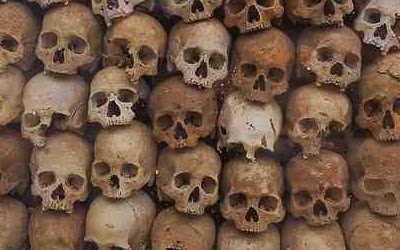 |
| Click picture to go to a site which discusses the idea of 'The Banality of Evil' |
“The task of history is the discovering of the constant and universal principles of human nature.” To what extent are history and one other area of knowledge successful in this task?
The idea of ‘constant and universal principles human nature’ implies, somewhat strangely, that knowledge about humans can be encapsulated in general laws which could in effect allow us to predict future behaviour. Given the conditions of a specific situation and how most people behave within it, most of the time and in most places, we can, with a high degree of probability, assert that an individual or group will behave in the same way should those conditions ever come about in the future. Here is an exploration of examples within History, Ethics and H Sciences that span between the 1940s to the present day...
During the post Second World War Nuremburg
trials, the prominent writer Hannah Arendt observed how some of the most
notorious Nazi war criminals appeared to be just normal citizens of whom we
wouldn’t take much notice in the street; often, some of them just seemed plainly
nice on the surface. She coined an
expression to embody this observation about the paradox of human nature: ‘the
banality of evil’. The implied thesis is
twofold: first, that in spite of being educated, intelligent and civilised, we
all have a dark, monstrous side to us and can turn to it at any moment of our
lives, especially when our consciences are influenced and undermined by those
in authority. And second, the common
sense belief that some of us are simply born evil and these ‘bad apples’, so to
speak, are the cause of all the nastiness in the world. But is this a ‘constant
and universal principle of human nature’? And how do we know the difference
between good and bad apples?
TOK students often present in their essays the
psychology experiments undertaken by Stanley Milgram who set out to test the
theses in the early 1960s. Milgram’s ‘Obedience
Experiments’ or “shock”
experiments, as they came to be known, explore the tension between
conscience and authority and offer a staggering conclusion: most people find it
emotionally easy to ignore their sense of moral responsibility, especially when
they see themselves as part of a chain of evil action and far away from the
final consequences of it. The idea is
that good or evil isn’t entirely in our genes or brains or spirit (as some
religions might have us believe), but our environment can deeply influence us
to act in evil ways. Again, is this ‘a constant and universal principle of
human nature’?
In 1971, Philip Zimbardo attempted to test the
conclusions reached by Milgram through another experiment: the notorious ‘Stanford County Jail’ experiments which
were reminiscent of situations described so vividly in Golding’s Lord of the Flies. The results of the
experiment are arguably more shocking than Milgram’s. The scheduled two week
experiment was shut down by Zimbardo after a matter of days because of what
Zimbardo came to call ‘the Lucifer effect’: how an individual’s character can
become so transformed that an otherwise ordinary person can commit
extraordinarily monstrous acts. To
extend a former analogy: a good apple can become bad when placed in a bad
barrel. In short, context is all. Where Zimbardo’s conclusions go further than
Milgram’s is in the insight that very often we don’t need an authority figure
to manipulate us to do evil acts; good people can turn evil simply by adopting,
or being assigned, a particular stereotype or role and put in a situation where
the rule of law is not enforced fully.
Two relatively recent examples from vastly
different cultures serve to illustrate how both Milgram’s and Zimbardo’s
experiments seem to have discovered a ‘constant and universal feature of human
nature’ as far as morality is concerned.
In 2004, we learned about the atrocities
committed by US soldiers at the Abu Graib detention camp
– acts of evil which were strongly reminiscent of the results of the Stanford
Prison Experiment.
In 2008, we learned about Shin
Dong-hyuk, a North Korean man born in a detention camp, who, being
allegedly the first person ever to have escaped from such a place, tells
stories of some of the most terrible atrocities that are committed in the name
of ‘democracy’, including his own act of condemning his mother to death by
telling guards of her plans to escape.
So we evolved into moral beings who also have
a capacity for immoral behaviour. Most
people, most of the time and in most places choose to be moral, but in certain
situations, even the most ordinary person can be driven to unspeakable acts of
evil.
If this sounds like a dark and miserable
story, read up on the experiments conducted by Steve
Sherman, the results of which suggest that education can help strengthen
our consciences against the vagaries of authority; especially education that
directs and guides us in creative enquiry into moral dilemmas and how we might
resolve them…
Monday, March 10, 2014
ToK Essay Prescribed Titles (November 2014)
The new ToK Essay titles for November 2014 are out and published online courtesy of: http://tok.ais.wikispaces.net/file/view/TOK+Prescribed+Titles+Nov2014.pdf
1.“Some areas of knowledge seek to describe the world, whereas others seek to transform it.” Explore this claim with reference to two areas of knowledge.
2. “Knowledge takes the form of a combination of stories and facts.” How accurate is this claim in two areas of knowledge?
3. “In the production of knowledge, it is only because emotion works so well that reason can work at all.” To what extent would you agree with this claim in two areas of knowledge?
4. “To gain an understanding of the world we need to make use of stereotypes.” With reference to two areas of knowledge, to what extent do you agree with this statement?
5. “The task of history is the discovering of the constant and universal principles of human nature.” To what extent are history and one other area of knowledge successful in this task?
6. “We may agree about general standards in the arts but disagree as to whether a particular work has artistic merit. In ethics the situation is reversed: we may disagree about ethical theories but we all know an unethical action when we see one.” Discuss.
Good luck to all the students around the world starting on your TOK essay adventure!
Wednesday, January 1, 2014
ToK Prescribed Essay Titles (May 2014): Question 6
“A skeptic is one who is willing to
question any knowledge claim, asking for clarity in definition, consistency in
logic and adequacy of evidence” (adapted from Paul Kurtz, 1994). Evaluate this
approach in two areas of knowledge.

Ideas about scepticism are closely linked to ideas about the certainty or lack of certainty of knowledge. Consider these three alternatives:
Philosophical or Cartesian Skepticism
Like with the expression ‘Knowledge is Power’, this Q is no doubt going to attract students who want to write about Descartes and his ‘method of doubt’ summed up in his famous cogito ergo sum. Descartes was willing to question everything, including his own existence, in an attempt to find those ‘clear and distinct ideas’ which would form the foundation of all human knowledge. His argument goes something like this:
P1. My body is something the existence of which I can doubt.
P2. My mind is something the existence of which I cannot doubt.
Conclusion: Therefore, I am the same as my mind; I am a thinking being.
Descartes claims that this is one absolutely certain piece of knowledge and with this in hand, he argued that the only certain knowledge we can have comes through reason and not the senses.
One of the great problems with this idea of knowledge is Descartes’ belief in the dualism of mind and body; he thought that they were separate entities and so left himself open to the extremely difficult issue of explaining HOW the two entities interact. If the body is physical and made of matter, how can something so non-physical and immaterial as a mind or soul possibly influence it or cause it to do anything? Without a clear answer to this question, Descartes’ explanation of how we make knowledge begins to collapse.
Scientific Skepticism
Scientific skepticism is less to do with issues about certainty of knowledge and more to do with the idea of testing knowledge against evidence. This has evolved alongside the ‘scientific method’ ever since Sir Francis Bacon introduced us to its basic principles in the 17th Century: theory, experiment, observation, prediction. Michael Shermer discusses a ‘Baloney Detection Kit’ which uses scientific principles to help us filter out strange beliefs by means of grounding our beliefs in pertinent modes of questioning and in evidence. The project of such skepticism is thereby to distinguish between scientific knowledge (eg. about influence of genes on human behaviour) and pseudoscientific knowledge (eg. about the influence of astrology on human behaviour.) Where scientific skepticism converges with philosophical skepticism is its insistence that scientific knowledge (or theory) is only provisional. Think for example about the theory of dark matter: the theory allows us to make predictions about this strange ‘stuff’ of nature, but we have little evidence to justify any KNOWLEDGE about how this phenomenon works. So we need a combination of better theory and better data to help justify that ‘dark mater’ exists.
A problem with skepticism is to sort out the skeptics from the so called ‘pseudoskeptics’ – those who use scientific language to discredit or refute beliefs but in reality fail to apply the scientific method rigorously. Consider the arguments of Deepak Chopra about consciousness and the afterlife in which he uses language from neuroscience to present his conclusions: "And life is, as he said, it's a process. It's one process. It's perception, cognition, emotions, moods, imagination, insight, intuition, creativity, choice making. These are not the activities of your networks. You orchestrate these activities through your synaptic networks. But if I ask you to imagine the color red or look at the color red, there's no red in your brain. There's just electrical firings." (Quoted in Michael Shermer, who calls this the ‘woo-woo’ approach to explaining beliefs.)
How do we differentiate between scientific skeptics and pseudo skeptics? Read this: ‘On Pseudo-Skepticism A Commentary by Marcello Truzzi’ or this Wikipedia article on pseudoskepticism which summarises Truzzi’s ideas neatly.
Religious Skepticism
This can take two possible forms: either using one’s faith to doubt scientific explanations about the world which manifests itself in questioning the knowledge of science (eg. that the universe began with a ‘big bang’) or having doubts about one’s own faith which manifests itself in questioning the grounds of one’s belief in God as a way of reaching a higher level of faith (eg. the problem of evil – why does God allow evil acts?) While questioning one’s faith can lead to a stronger knowledge of self and purpose in life, bringing empowerment and wellbeing (think of the works of Martin Luther King and Gandhi), the questioning of science can lead to a more dogmatic and narrow minded approach to knowledge bringing great disharmony, bigotry and destruction (think of Galileo’s imprisonment for asserting the truth of the heliocentric theory). In its most extreme form, religious skepticism can lead to the kind of radical ideological hold on faith which leads to terrorism.
Read some of these articles on the positive effects of religious doubt while some of the dangers of religious uncertainty are explored here...
A conclusion
The language we use is so important in these matters. Proper scientific always tries to establish knowledge ‘beyond reasonable doubt’ – the theories of science are provisional and true to a high degree of probability and can be modified when better evidence comes along. Skeptics never ask for knowledge ‘beyond (all possible) doubt’. In science (and philosophy), it’s a good thing to be familiar with the ambiguities of the word ‘proof’.
Consider a real life issue in this light: the problems in Syria in September 2013 after Assad had allegedly used chemical weapons against civilians. The US government was ready to attack because it believed there was proof ‘beyond any reasonable doubt’ that Assad had used chemical weapons. The Russians argued to wait until the it could be proved ‘beyond doubt’ that chemical weapons had indeed been used by Assad.
Usually, when skepticism of any kind asserts that knowledge is true ‘beyond (all possible) doubt’ alarm bells should ring. Read this post by Stephen Law about ‘scales of reasonableness’ to see the difference. What sort of knowledge can BE beyond all possible doubt? In the Syrian case, however, we see that while the US politicians used words that sounded good, it was the Russian President’s caution that actually won out and prevented an all out strike – in spite of his fuzzy request for something that any self-respecting skeptic would never ask for: knowledge beyond (all possible) doubt...
Subscribe to:
Posts (Atom)